

Jul 13, 2026
Freestyle Technique & Training: The Fundamentals Every Open Water Swimmer Needs
Freestyle Technique & Training: The Fundamentals Every Open Water Swimmer Needs
If you want to swim faster and further with less effort, the answer isn't just more distance — it's better technique. Whether you're training for your first open water event or refining your stroke after years in the water, these four fundamentals form the foundation of efficient freestyle swimming.
1. Freestyle Kick Technique
There's no need to kick a lot unless you're sprinting. When distance swimming, reduce your kick — your legs are there to stabilise your body position, not power you through the water.
Keep your knee very slightly bent and your foot relaxed. The kick should stay small, roughly within a 30cm range. Go wider than that, and you disturb your slipstream; too big a kick causes vertical oscillation, which creates drag rather than propulsion.
The action itself should feel like squeezing the water behind you, not thrashing at it. Think compression, not force.
2. Bilateral Breathing
Bilateral breathing (breathing to both sides) isn't essential — but it can help with orientation, sighting, and adapting to conditions like a swell or another swimmer on one side.
That said, breathing to your "unnatural" side can create tension and disrupt stroke timing if it's not something you've trained. Breathing to one side is perfectly fine, as long as your body maintains symmetrical rotation and balance.
The key is this: each arm entry should pair with equal hip and shoulder rotation, and the breath should fit naturally into that rotation — not interrupt it.
3. High Elbow Catch & Recovery
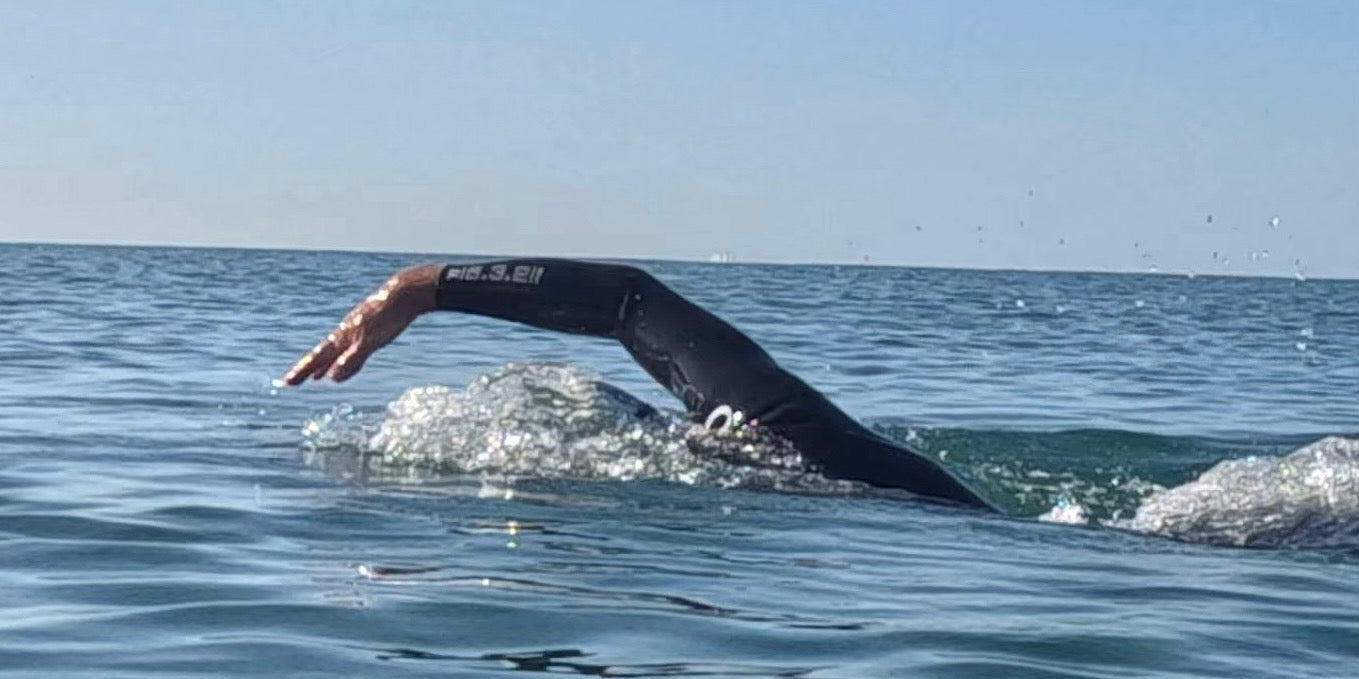
Good freestyle technique comes down to a few universal principles: a high elbow catch, a high elbow recovery, connected rotation, a smooth hand entry, and a streamlined body position.
But here's the part that gets missed — every swimmer applies these principles differently. Your body shape, flexibility, and range of motion will all shape how your stroke actually looks. Not everyone can (or should) copy an elite swimmer's exact stroke. The goal isn't imitation — it's adapting these principles to fit your own body.
4. Building Consistency in Training
Technique only improves through repetition, and repetition only happens through consistency.
Stay technically focused throughout every swim. Covering a distance without paying attention to your form is just burning time and energy — cover that same distance with attention to technique, and you're actually training. Start with shorter distances if you need to, but maintain form for the entire swim rather than letting it slip once you're tired.
Build consistency by setting an easily achievable target, and make your training fit your life — not the other way around. There's no overnight success in improving your swimming, and building true endurance takes months, not weeks. Not every session is going to be great. Just keep turning up.
The Takeaway
None of these fundamentals work in isolation. A well-timed breath depends on good rotation. Good rotation depends on a controlled kick. And none of it improves without consistent, technically-focused training. Master the basics, apply them to your own stroke, and keep showing up — the rest follows.
Looking for a wetsuit built around real open water conditions, not lab specs? Explore our range built by swimmers who train exactly like you do.